Existing-line cleaning
Start with visible gutter debris, the downspout adapter, accessible cleanouts, fittings, and the outlet. A weak or absent discharge does not by itself identify the failed segment.
 Cape Coral Drainage GuideCape Coral yard drainage requests
Cape Coral downspout drainage service
Get help tracing roof runoff from the gutter outlet through a downspout extension or buried solid-pipe route to an accessible, property-appropriate outlet.
Cape Coral drainage requests. Tell us where water collects, what appears to feed it, and how you prefer to be contacted. We review every request and follow up with clear next steps.
Problem
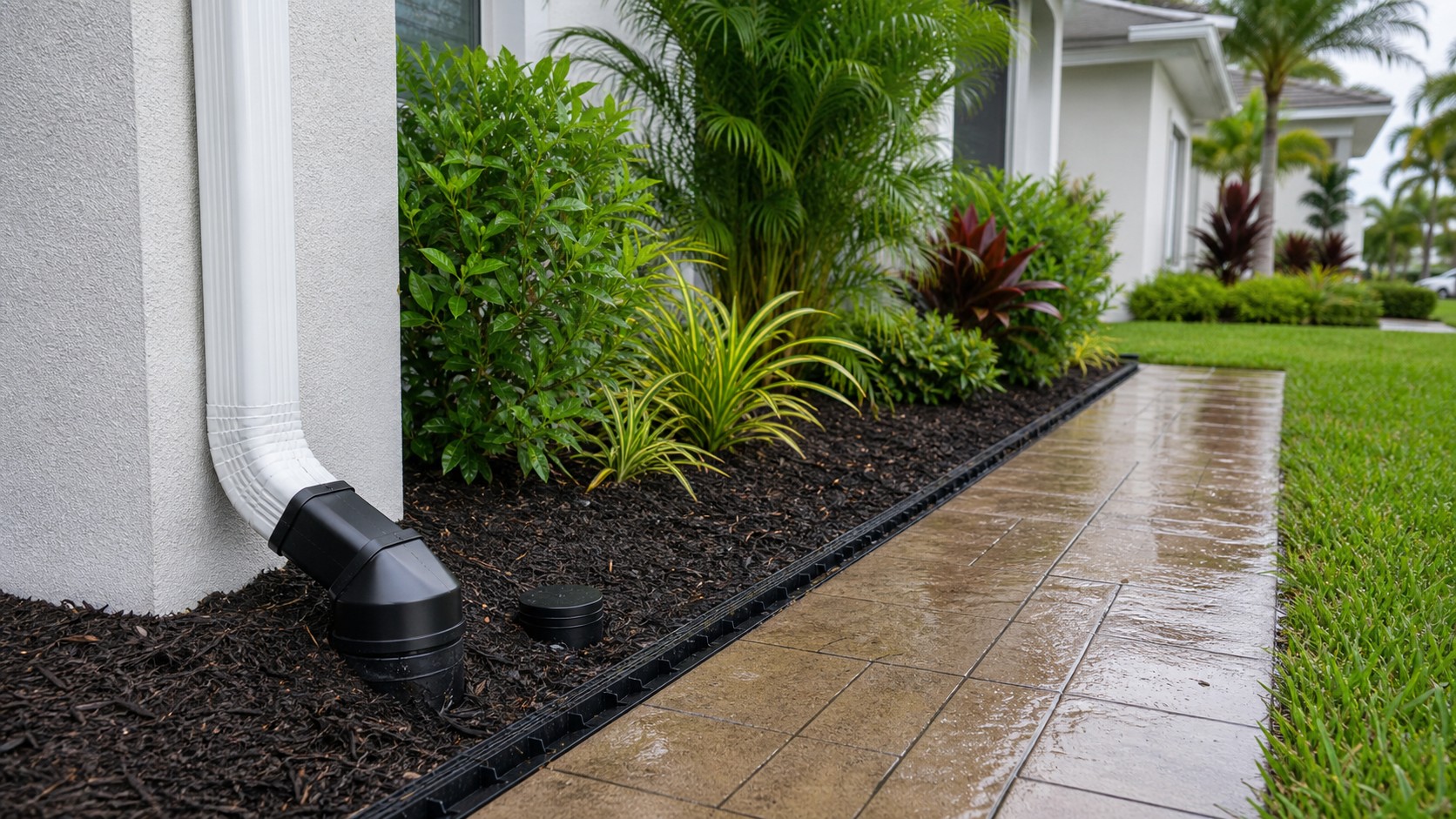
Roof runoff can overflow a small planting bed, wash out mulch, cross hardscape, saturate a side yard, or back up through an existing buried downspout line when the route, cleanout, or outlet is not working as intended.
Source-to-outlet scope
Roof water is already concentrated before it reaches the ground. A useful service request follows that water through every connection rather than naming a buried pipe without an outlet.
Identify the roof section, gutter, and downspout feeding the problem area instead of treating every wet spot as groundwater.
Document the elbow, adapter, screen, basin, or transition where the downspout enters an extension or buried line.
Trace the solid-pipe route, fittings, slope changes, cleanouts, hardscape crossings, utilities, roots, and access constraints.
Locate the pipe end, emitter, surface discharge, or other proposed outlet and confirm that it does not create a new problem or cross a public boundary.
Keep adapters, cleanouts, transitions, and the outlet findable so an existing line can be inspected before replacement is assumed.
Service comparison
The observed failure point should determine the service discussion. Cleaning an accessible obstruction, repairing one damaged segment, and replacing an entire route are different scopes.
Start with visible gutter debris, the downspout adapter, accessible cleanouts, fittings, and the outlet. A weak or absent discharge does not by itself identify the failed segment.
Record separated fittings, crushed or exposed pipe, settlement, root conflicts, hardscape damage, and any section where water surfaces during rain.
Put pipe material, diameter, fittings, cleanouts, route, burial and restoration limits, utility marking, and the proposed outlet into the written scope.
Where an above-ground extension, splash block, or landscaped discharge is considered, verify that water has a stable path away from the structure and does not create erosion, ponding, or a neighbor impact.
Private and public boundary
The EPA notes that redirecting a downspout is not appropriate everywhere and that local requirements and the receiving location matter. Cape Coral manages stormwater features within the public right-of-way, and work involving swales, culverts, driveway areas, regrading, or other public drainage features may need City review. Active public drainage concerns can be reported through 311.
Before excavation, follow the Sunshine 811 notification process. Utility marks do not identify every private line, irrigation component, root conflict, property boundary, or permitted outlet.
Private roof-runoff estimator
Use the roof footprint and measured rain depth to estimate the gross volume of water leaving the roof during one rain event. This helps document whether concentrated roof runoff lines up with a recurring wet area.
Estimated gross roof runoff
1,246 gallons
2,000 sq ft x 1 in x 0.623 = 1,246 gallons
Example values are shown. Adjust the measurements to estimate one rain event.
Transparent method. The EPA rainwater collection method uses 0.623 gallons per square foot per inch. This calculator shows gross volume before splash, wind, gutter overflow, and other collection losses.
Planning boundary. This estimate does not size gutters, downspouts, pipes, drains, storage, pumps, infiltration systems, or outlets. A property-specific review still needs to consider slope, soil, route, discharge, utilities, public stormwater features, and applicable requirements.
Privacy. Measurements stay in this browser and are not transmitted, retained, or added to the site analytics event log.
Downspout drainage service request
Send the roof-water source, affected area, existing pipe details, Cape Coral ZIP code, desired timing, and preferred reply method without leaving this page.
Evaluation
Roof area, gutter condition, and the section feeding each downspout.
Existing adapters, solid conveyance pipe, cleanouts, fittings, and outlet location.
Conflicts with irrigation, roots, utilities, and hardscape.
Whether cleaning, localized repair, rerouting, surface discharge, or another drainage approach fits the observed problem.
Cost depends on property layout, drainage path, materials, trenching requirements, discharge location, and site conditions.
Local reference points
These industry and public references help organize visible property conditions and separate private yard drainage questions from stormwater, right-of-way, utility-marking, and seasonal rainfall context.
Related services
Useful resources
Questions
A buried route may convey roof runoff when its pipe, fittings, slope, cleanouts, utility conflicts, and outlet are suitable for the property. The complete route should be documented before digging.
A line whose job is to convey already-collected roof runoff is generally discussed as solid pipe. Perforated pipe has a different subsurface collection role. A property-specific scope should identify every pipe segment and transition.
Possible causes include gutter or adapter debris, a blocked fitting or outlet, roots, settlement, a damaged pipe, an inaccessible cleanout, or a route that cannot move the incoming flow. The visible inlet and outlet should be checked before assuming the entire line needs replacement.
They may share a route in some systems, but roof area, rainfall, pipe capacity, fittings, cleanouts, route, and outlet conditions need to be evaluated rather than assuming every connection can be combined.
Gross roof runoff is about 0.623 gallons per square foot per inch of rain before collection losses. The on-page calculator is a planning aid and does not size gutters, downspouts, pipes, storage, or outlets.
Sunshine 811 says to notify at least two full business days before digging so member utilities have time to respond. Private lines, irrigation, roots, hardscape, and property boundaries still need separate review.
Request help