Cape Coral drainage service

Driveway and Patio Drainage in Cape Coral

Request help with rainwater that crosses or pools on a Cape Coral driveway, patio, paver field, walkway, courtyard, or garage approach.

Independent connection service. Cape Coral Drainage Guide receives requests directly. If a suitable local drainage professional is selected, and with your authorization, relevant request details may be shared with that one professional for a response.

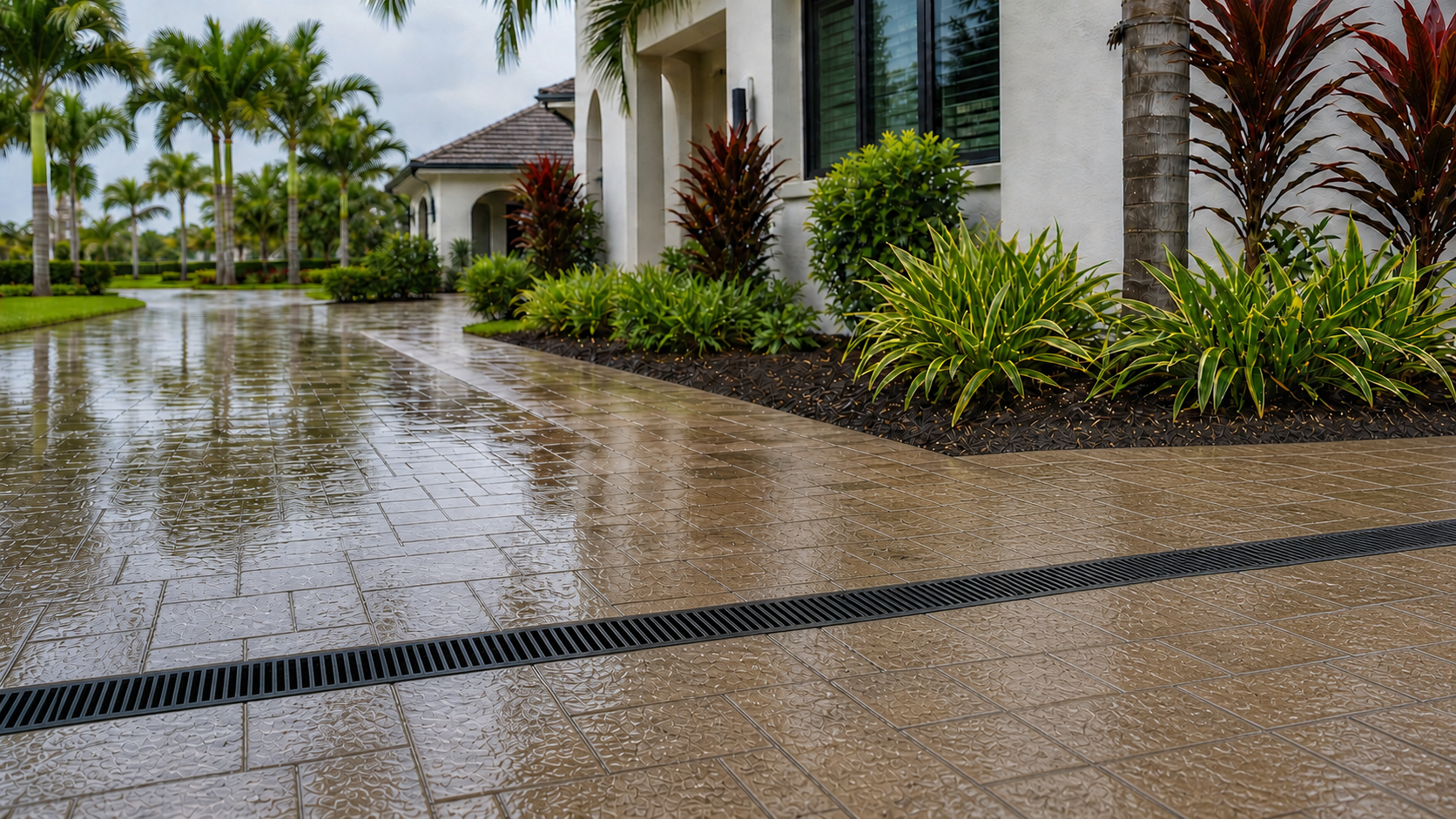
Continuous flush channel drain collecting rainwater across wet pavers at a Cape Coral driveway

Problem

What This Service Helps Sort Out

Hardscape drainage problems can involve the surface slope, a low transition, roof runoff, landscape washout, an undersized or blocked inlet, a disconnected route, or an outlet that no longer works as intended.

When it may help

  • Water crosses the driveway or reaches a garage threshold.
  • A patio, paver field, courtyard, or walkway holds water after rain.
  • Paver joints, hardscape edges, or nearby landscape beds wash out.
  • An existing channel drain, grate, basin, pipe, or outlet drains slowly or overflows.
  • You need a written source-to-outlet scope for new drainage, repair, or replacement.

Complete hardscape drainage scope

Follow Driveway and Patio Water From Source to Outlet

A useful driveway or patio drainage plan does more than name a grate. It connects the repeatable water source, hardscape shape, collection method, buried route, outlet, restoration, and future service access so the visible inlet belongs to a complete private-property system.

  1. 01

    Find the source

    Record whether the repeatable water follows rainfall, a roof edge or downspout, irrigation, a neighboring flow path, landscape washout, or an existing drain that backs up.

  2. 02

    Read the hardscape

    Trace driveway, patio, paver, walkway, courtyard, and garage-approach slopes, low seams, settled areas, edges, thresholds, and the width and direction of surface flow.

  3. 03

    Match the collection point

    Compare line collection where runoff crosses hardscape, point collection where water converges, grade or edge correction, source control, or a combined approach.

  4. 04

    Trace the connected route

    Identify the pipe path, fittings, transitions, turns, cleanouts, crossings, utility and irrigation conflicts, access limits, and every surface that would be disturbed.

  5. 05

    Confirm the outlet and finish

    Name the proposed endpoint, public or private boundary, erosion protection, maintenance access, paver or concrete restoration, cleanup, and the conditions that still require on-site confirmation.

Scope rule: a channel, grate, or basin is only the collection point. The connected pipe, outlet, restoration, and cleaning path are part of the drainage result.

Line collection or point collection

Match the Inlet to the Way Water Reaches It

A channel drain collects across a line. It is commonly considered where runoff crosses a driveway, patio, walkway, courtyard, paver field, or garage approach. The surrounding slope must lead water to the channel, and the channel still needs a connected route and outlet.

A catch basin or area drain collects at a point. It fits a location where nearby surfaces direct water into one low area. Moving a basin away from the actual low point or treating it as the answer to broad wet soil can leave the original problem unchanged.

Either method can be part of a larger plan that also changes a downspout, corrects a settled edge, or connects multiple inlets. The property visit should compare the observed flow shape before a component is selected or placed.

Compare line and point collection
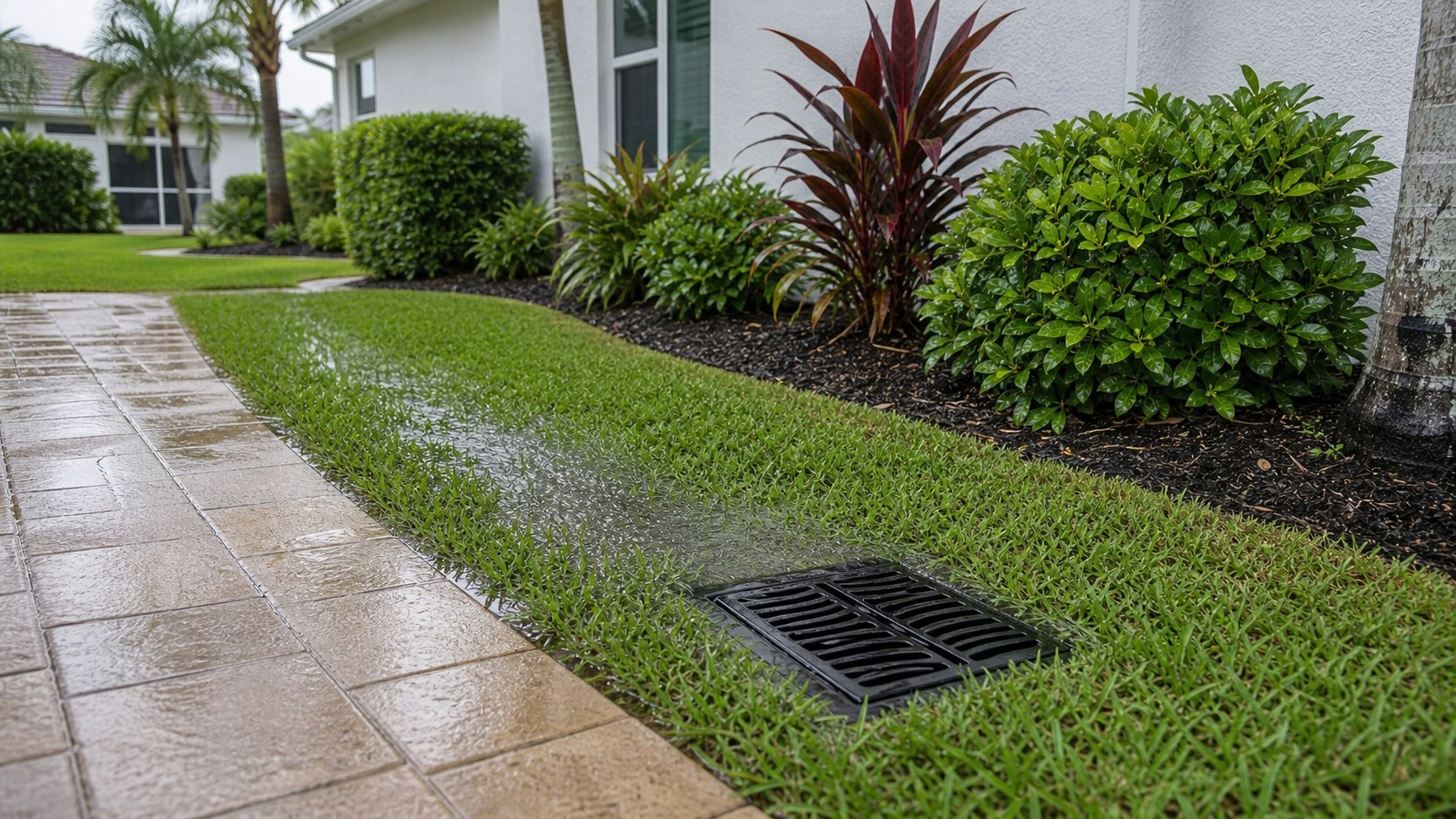
Private catch basin at a defined low point beside pavers after rain in Cape Coral
A point inlet belongs where surrounding runoff converges and remains connected to a maintainable route and outlet.

Possible service paths

Five Approaches a Property Review May Compare

The right conversation begins with the water path, not a predetermined product. More than one approach can be appropriate when roof runoff, hardscape, landscape edges, and existing drainage interact.

01

Channel drain

Useful to evaluate when a visible band of runoff crosses a driveway, patio, paver field, walkway, courtyard, or threshold. The grate, traffic or pedestrian context, connected pipe, access, outlet, and surrounding surface all belong in the same scope.

02

Catch basin or area drain

Useful to evaluate when surrounding runoff reaches one identifiable low point. The inlet should follow the observed flow pattern and still needs sediment access, a connected route, and an inspectable outlet.

03

Surface or edge correction

Settled pavers, a low concrete transition, an inward-sloping edge, or landscape material washing over hardscape can change the collection conversation. The scope should state what grade or edge work is included and where the redirected water will go.

04

Downspout or source change

Roof runoff can overwhelm a patio edge or driveway low point. The contributing roof section, adapter, solid-pipe route, cleanout, outlet, and interaction with the proposed surface drain should be documented.

05

Combined drainage route

Some properties need source control plus line or point collection. A combined scope should show how the components connect, where maintenance occurs, and which outlet serves the completed route.

Ready to describe the hardscape water path?

Send the affected surface, runoff source, visible drainage, route and outlet clues, access limits, Cape Coral ZIP code, timing, and preferred reply method. Driveway or patio drainage is already selected.

Request driveway or patio drainage service Call (941) 681-8056

Written proposal checklist

Seven Parts a Complete Hardscape Drainage Scope Should Name

Use the same categories when comparing proposals. They make it easier to see whether one price includes the full route and restoration while another covers only a visible drain component.

Observed condition
Affected hardscape, repeatable source, rainfall or irrigation timing, duration, depth or spread observations, visible erosion, prior work, and the result the proposed work is intended to achieve.
Collection geometry
Channel location and ends or basin location and low-area geometry, grate style, traffic or pedestrian context, transitions, nearby thresholds, and how surrounding pavers or concrete meet the inlet.
Connected drainage
Pipe material and limits, fittings, turns, transitions, connections, cleanouts, crossings, existing components being reused, and how every inlet reaches the proposed outlet.
Outlet and boundaries
The endpoint, erosion protection, access, ownership or control, and any neighboring property, canal, swale, culvert, street, or public right-of-way condition that needs separate confirmation.
Excavation and conflicts
Hardscape cuts or removal, dig limits, utility notification, private lines, irrigation, roots, structures, pool equipment, narrow access, unsuitable material, and the process for an unexpected condition.
Restoration and cleanup
Paver reset, concrete finish, joints, base repair, turf or bed restoration, irrigation repair, excess material, debris removal, protection of adjacent surfaces, and excluded finish work.
Maintenance and closeout
Removable-grate access, basin or channel cleaning, cleanout and outlet locations, route records, expected upkeep, completion criteria, schedule, written change control, and warranty terms if offered.
Property-specific review

What to Document in Four Common Hardscape Areas

Photos taken during or immediately after rain are especially useful when they show a wide view of the flow direction, the deepest or most vulnerable point, nearby inlets, and the possible path beyond the hardscape.

01

Garage approach

Document the driveway crown or low edge, threshold elevation, width of runoff, nearby roof discharge, vehicle path, existing grate condition, and a route that does not stop at the garage-side inlet.

02

Paver patio or courtyard

Look for settled fields, low joints, inward-sloping edges, roof or screen-enclosure runoff, landscape washout, pedestrian use, removable surfaces, and the outlet available beyond the patio.

03

Concrete patio or walkway

Trace the direction water crosses each slab or seam, any doorway or foundation concern, low transitions, possible saw-cut limits, adjacent beds, and how the finish would be restored.

04

Existing channel or basin

Locate every removable grate, channel section, basin sump, connection, cleanout, pipe end, overflow path, and outlet. Compare cleaning, localized repair, rerouting, or replacement only after the connected system is understood.

Cape Coral and excavation boundary

Separate private hardscape drainage from public stormwater features

The City of Cape Coral Stormwater Division maintains swales, drainage pipes, catch basins, canals, and related facilities within the public right-of-way. Report a clogged, damaged, or sunken public feature through Cape Coral 311 while using this request for the driveway, patio, paver, walkway, courtyard, or other private-property drainage concern.

Before private excavation, follow the Sunshine 811 utility-notification process and identify irrigation and other private facilities separately. Confirm the property boundary, proposed outlet, applicable permits through Cape Coral Permitting Services, and any work affecting a swale, culvert, driveway approach, canal, street, or right-of-way before work begins.

Property-specific confirmation: the on-site review must confirm elevations, capacity, component selection, utility and irrigation conflicts, boundaries, outlet permission, restoration details, and any permit, licensing, engineering, surveying, or City requirements for the actual scope.

Cape Coral driveway and patio drainage request

Request Driveway or Patio Drainage Service

Send the hardscape water pattern, affected area, existing drainage, possible route and outlet, Cape Coral ZIP code, desired timing, and preferred reply method without leaving this page.

  1. Trace the runoff.State where water starts, whether it crosses a line or reaches one low point, what rain triggers it, and which garage approach, driveway, patio, paver field, courtyard, or walkway is affected.
  2. Map visible drainage.Include every grate, channel, basin, pipe connection, cleanout, outlet, downspout, swale, culvert, hardscape edge, and area that would need restoration.
  3. Name the service result.Explain whether you need cleaning, repair, replacement, a new collection route, or a property visit to compare channel, basin, grading, source-control, or combined options.
Prefer to speak with someone? Call (941) 681-8056 Calls are not recorded.
Hardscape drainage source, collection, route, outlet, and restorationYour reply choice by phone or emailEncrypted with 30-day deletion
1 How to reach you

Select the way you want a response and enter the phone number or email address that should be used.

2 Request location

Use the Cape Coral ZIP code and broad service category to route the first follow-up to the right subject.

3 What is happening

Describe where runoff starts, whether it crosses the driveway or patio or converges at one low point, every visible grate or basin, the possible route and outlet, hardscape restoration limits, and the result you need.

Cape Coral Drainage Guide receives this request first. Provide either a phone number or email that matches your preferred contact method. The provider-sharing choice is optional and does not affect whether the Guide receives your request. Request details are encrypted for follow-up and automatically deleted after 30 days. Photo upload is not enabled. Review the privacy policy.

Evaluation

What a Property Review Typically Considers

The repeatable water source, hardscape slope, low points, edges, thresholds, and direction or width of surface flow.

Whether water crosses a line or converges at one point, plus the fit of a channel drain, area inlet, catch basin, grading correction, downspout change, or combined approach.

Every connected pipe, fitting, transition, cleanout, crossing, access constraint, and restoration limit between collection and discharge.

The proposed outlet, erosion and neighboring-property concerns, and any swale, culvert, canal, street, or public right-of-way boundary.

Traffic or pedestrian load context, paver or concrete work, utilities, irrigation, maintenance access, and permit or credential checks that apply to the actual scope.

Cost depends on property layout, drainage path, materials, trenching requirements, discharge location, and site conditions.

Local reference points

Useful Sources for This Drainage Topic

These industry and public references help organize visible property conditions and separate private yard drainage questions from stormwater, right-of-way, utility-marking, and seasonal rainfall context.

Related services

Related Drainage Help

Useful resources

Related Checklists and Comparisons

Questions

Drainage FAQs

Can a channel drain help a driveway?

A channel drain can intercept a band of runoff that crosses hardscape, but the review still needs to confirm surrounding slope, grate and load context, a connected pipe route, a workable outlet, cleaning access, and restoration.

What is the difference between a channel drain and a catch basin?

A channel drain collects along a line where surface water crosses a driveway, patio, walkway, or threshold. A catch basin or area drain collects at one low point where surrounding flow converges. Either inlet needs a complete route and outlet.

What if water pools on a patio or paver area?

The review should trace surface slope, low edges, settled areas, nearby roof runoff, landscape washout, existing inlets, the possible collection method, and where collected water can discharge without creating another problem.

Can driveway or patio drainage require removing concrete or pavers?

Sometimes. A written scope should identify every hardscape cut or removal area, channel or basin placement, connected pipe route, excavation limit, paver reset or concrete restoration, cleanup, and important exclusions.

Can an existing driveway drain be cleaned instead of replaced?

Possibly. Start by locating removable grates, basin sumps, cleanouts, connected pipe, outlet flow, damaged sections, settlement, and debris. The observed condition determines whether cleaning, localized repair, rerouting, or replacement should be compared.

Who handles a street catch basin, roadside swale, or public drainage pipe?

Cape Coral maintains stormwater facilities within the public right-of-way and accepts reports through 311. Use the service request for the private driveway, patio, paver, walkway, or yard drainage problem, and report the public feature separately when it is involved.

Should utilities be marked before hardscape drainage excavation?

Sunshine 811 says anyone planning to dig must notify before excavation. Member utilities mark facilities they own; irrigation and other private facilities can require separate identification before work begins.

Request help

Tell us what drainage issue you are dealing with.

Call now Request estimate