Compare subsurface collection
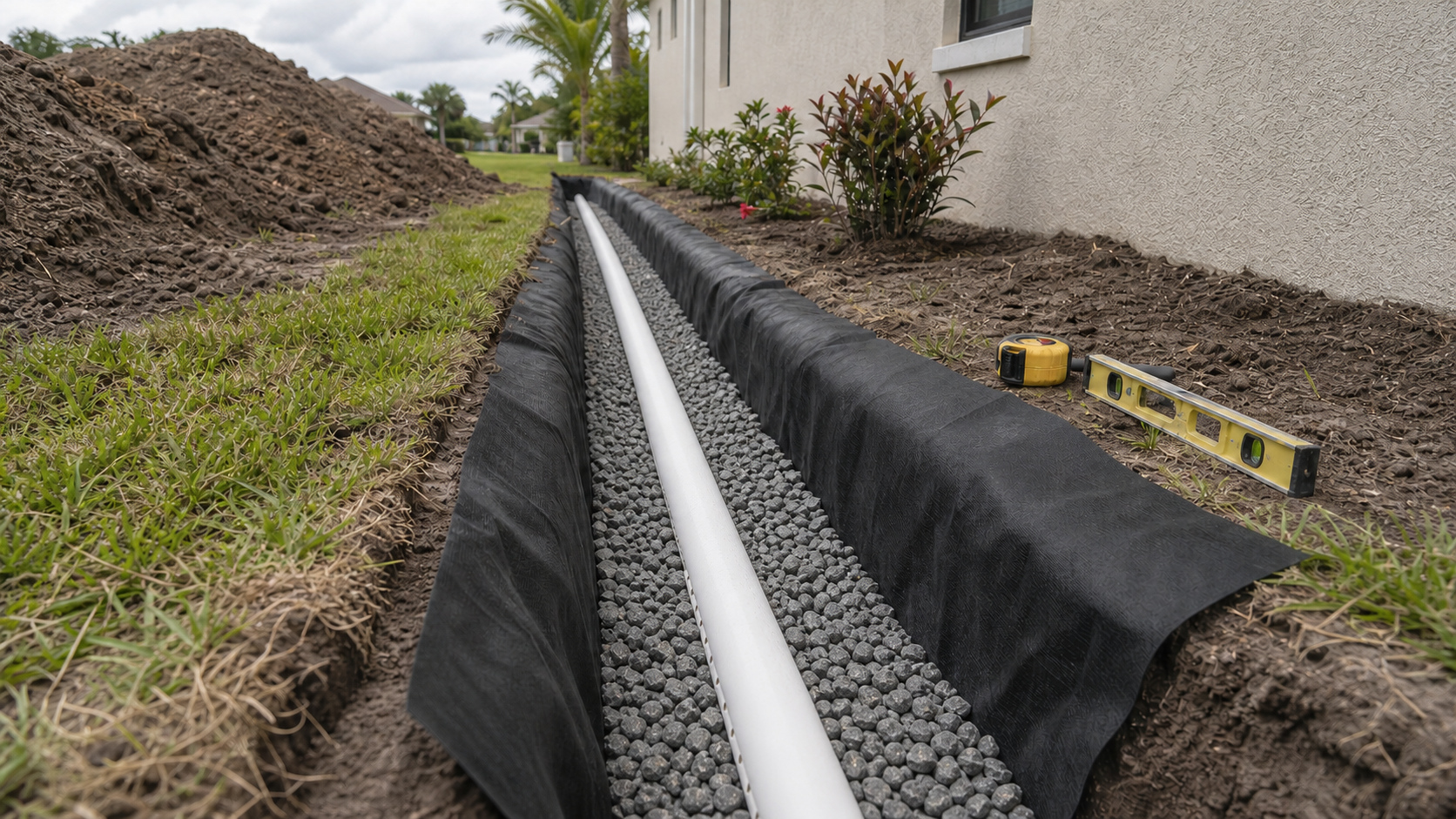
A French drain discussion may fit when the route and outlet support collection along a permeable trench.
Compare drainage systems Cape Coral Drainage GuideCape Coral yard drainage requests
Cape Coral drainage service
Request French drain installation for recurring wet soil, side-yard water, or runoff. The property review should confirm the source, collection zone, route, outlet, access, utilities, and restoration before scope is written.
Cape Coral drainage requests. Tell us where water collects, what appears to feed it, and how you prefer to be contacted. We review every request and follow up with clear next steps.
Problem
A French drain is not a one-size-fits-all trench. A useful installation plan starts with the water source and must also explain soil and grade conditions, the collection method, pipe route, outlet, maintenance access, utilities, and nearby structures.
Scope-first comparison
A French drain label does not explain the full installation. Before comparing estimates, trace the water path from source through collection and conveyance to a maintainable outlet.
Identify whether the wet area is tied to rainfall, roof runoff, irrigation, an isolated low point, broad soft soil, or another visible source.
State whether water enters through a permeable trench, a surface inlet, a downspout connection, or a combination of collection points.
Separate perforated collection pipe from solid conveyance pipe and show the proposed route, transitions, and accessible cleaning points.
Name the proposed discharge or connection point and who must confirm that it is usable, allowed, and unlikely to create another drainage problem.
Explain how inlets, cleanouts, transitions, and the outlet can be located and maintained after the trench and surface are restored.
Completeness check: a trench description is not a complete drainage scope when the water source, connections, outlet, maintenance access, or restoration are still undefined.
Quote anatomy
Use these categories to compare whether two proposals describe the same work. They are quote-review checkpoints, not dimensions or construction specifications.
Call with the ZIP code, observed water pattern, nearby downspouts or hardscape, possible route, and outlet context.
Installation sequence
The strongest written scopes make important decisions visible before excavation and preserve useful evidence after restoration.
Record the wet-area shape during or soon after rain, how long it remains, nearby runoff sources, and the possible route and outlet.
Review access, utilities, irrigation, roots, hardscape, adjoining property, the proposed outlet, and any City or right-of-way boundary.
Put materials, quantities or limits, connections, route, outlet, access points, restoration, exclusions, and change handling into the written scope.
Confirm that the described collection, conveyance, and outlet chain can be inspected before the work is covered and restored.
Retain the route, component locations, photos, maintenance instructions, warranty terms if offered, and the final approved scope.
System fit
Start with the observed water pattern. Several components can be combined, but each has a different collection or conveyance role.
A French drain discussion may fit when the route and outlet support collection along a permeable trench.
Compare drainage systemsA catch basin may better match water converging at one visible low point, but it still needs a connected route and outlet.
Compare point and line collectionA channel drain can collect sheet flow along a driveway, patio, threshold, or walkway before connecting to conveyance.
Review surface drainageSolid pipe may move water already collected at a downspout; that is a different role from collecting water through a French drain trench.
Review downspout routingA drain should not substitute automatically for correcting a water source or a surface-grade issue that needs property-specific review.
Review grading questionsCity and excavation boundary
Before excavation, use Sunshine 811 for the utility-marking process. When a route or outlet may affect a swale, culvert, driveway area, regrading, fill, or another right-of-way or public stormwater feature, review the City Surface Water Management guidance and City flood-protection guidance. Active public drainage concerns can be reported through Cape Coral 311.
This guide does not determine property boundaries, permit requirements, utility clearance, engineering adequacy, or whether a proposed outlet is authorized.
French drain installation request
Send the water pattern, likely source, affected area, Cape Coral ZIP code, route or outlet context, desired timing, and preferred reply method without leaving this page.
Evaluation
Trench route, depth, gravel, fabric, pipe, and cleanout planning.
Available fall and discharge location.
Potential conflicts with utilities, irrigation, roots, hardscape, and existing swales.
Whether a surface drain, channel drain, or regrading would be more appropriate.
Cost depends on property layout, drainage path, materials, trenching requirements, discharge location, and site conditions.
Local reference points
These industry and public references help organize visible property conditions and separate private yard drainage questions from stormwater, right-of-way, utility-marking, and seasonal rainfall context.
Related services
Useful resources
Questions
It may help when the water source, soil, slope, route, and discharge location support subsurface collection. A site review is needed before choosing a drain type.
No. Some problems are better handled with downspout routing, a surface inlet, a channel drain, grading corrections, source control, swale work, or public stormwater reporting.
Compare a written route, collection method, pipe and aggregate descriptions, filter boundary, connections, outlet, cleanout or inspection access, utility coordination, surface restoration, exclusions, and closeout evidence. Exact components remain property-specific.
Not necessarily. A French drain generally collects water along a permeable trench, while solid pipe commonly conveys water already collected at a downspout, basin, or other inlet. A scope should distinguish collection pipe from conveyance pipe.
Maintenance depends on the system. Ask how grates, basins, cleanouts, pipe transitions, and the outlet can be found and accessed, what signs indicate restricted flow, and what maintenance documentation remains after installation.
Confirm the route, utility-marking process, irrigation and root conflicts, access, private-property and right-of-way limits, possible City requirements, outlet authority, and how adjoining property will be protected before digging begins.
Request help